
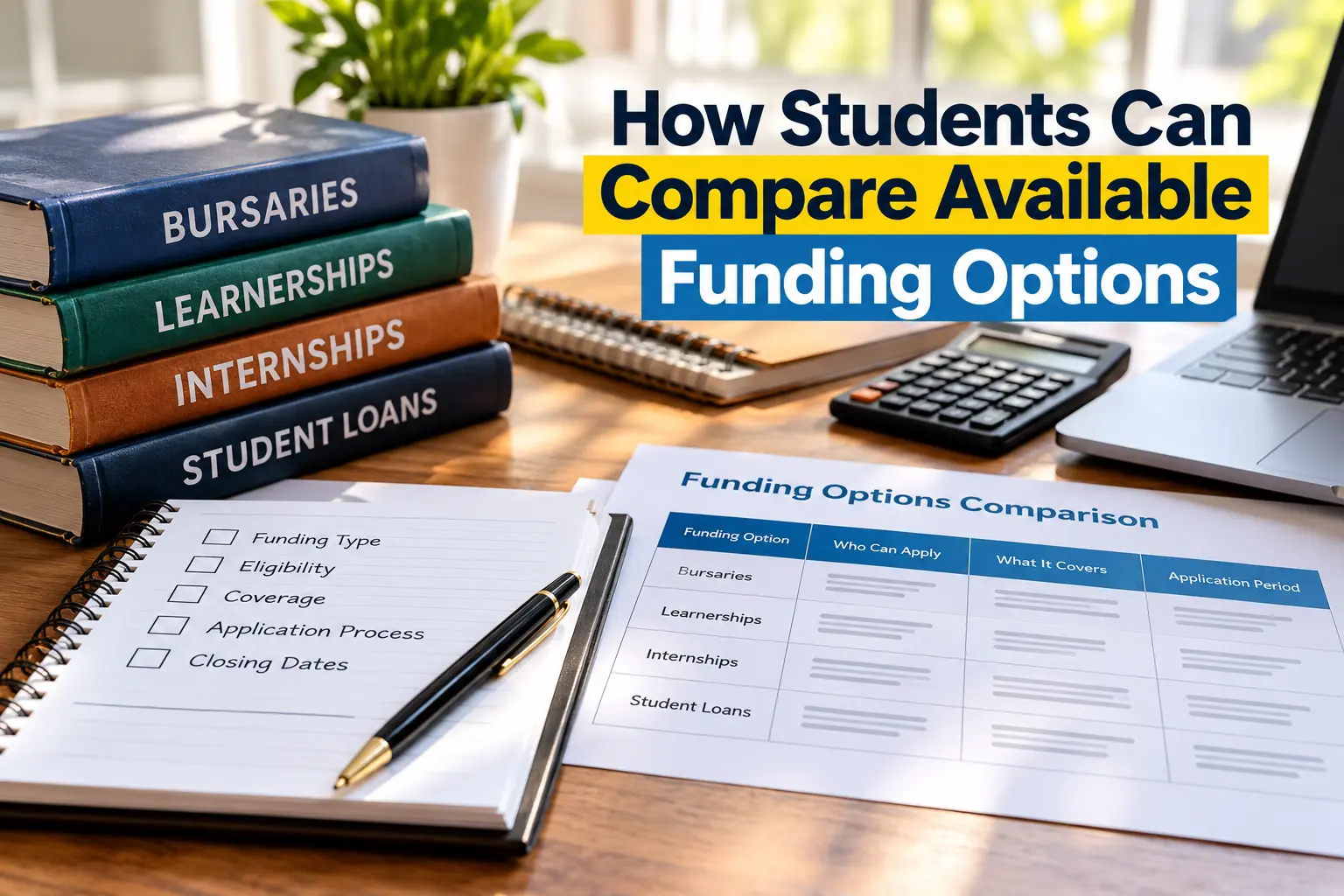
South African students with a plan to study in 2027 may be eligible for financial assistance through Sector Education and Training Authorities (SETA). There are many choices to consider, though, before investigating one funding option. Applicants should compare the qualifying criteria, application processes, financial benefits and attached conditions for each bursary opportunity.
Unlike one nationwide programme, SETA funding opportunities are spread across multiple economic sectors. Not every institution, qualification or application method is the same.
Students applying for a bursary should not assume they will find a university-specific opportunity, an online-form process and identical requirements in every sector.
By comparing SETA bursaries 2027, applicants can discover which funding choices align with their needs and apply before the relevant closing date.
1. Compare Qualifications to Find Relevant SETAs
The first step in identifying SETA bursaries 2027 is to explore which authorities may offer the relevant funding. Each SETA covers different areas of the economy and skills development, and applicants should select opportunities relevant to their own qualification.
The table below can help students begin their SETA bursary search.
SETA name Main sector/interest
FASSET Finance, accounting and related financial services
CETA Construction and the built environment
AgriSETA Agriculture and related industries
ETDP SETA Education, training and development
Services SETA Business and services-related occupations
merSETA Manufacturing, engineering and related industries
MQA Mining and minerals-related industries
CHIETA Chemical industries
INSETA Insurance and related financial services
BANKSETA Banking and related financial services
HWSETA Health and social development
SASSETA Safety, security and related services
These are general guidelines, and a bursary applicant should always confirm that a specific SETA will cover the intended qualification and institution for the relevant funding cycle.
For example, a student wishing to study accounting could investigate FASSET bursaries, while someone interested in mining might explore MQA opportunities. Applicants can also investigate multiple authorities if the qualification covers more than one field.
It is important to be aware of the application-specific rules, though, since some SETAs prohibit simultaneous bursaries, disclose other funding or penalise unsuccessful applications.
2. Compare Application Processes for SETA Bursaries
Application processes vary between SETA bursaries 2027, and students should not assume they will find the same instructions in every notice.
At a minimum, each applicant should compare the process for submitting the application and the specific documents required.
There are three broad application categories to be investigated, though students should not assume these descriptors apply to every SETA or authority.
Application route Description
Institution-managed funding The university or TVET college financial aid office administers the application.
Direct applications The SETA bursary notice includes instructions for submitting an application to the relevant authority.
Institution-communicated opportunities The university or college funding department communicates application instructions directly to eligible students.
An example of the latter is the SETA bursary applications at UNISA. Eligible students should visit the relevant SETA bursaries information page and follow the instructions given for their specific qualification and funding category.
Anyone wishing to apply for a SETA bursary should begin with the UNISA SETA bursaries information page but should always investigate the latest notice from the relevant authority.
It is a common misconception that finding this kind of information means applications are currently open. Always check the latest SETA bursary notice before submitting applications.
3. Compare Eligibility Requirements for SETA Bursaries
Eligibility requirements can dictate whether an application will be received, and students should compare the financial, personal and academic criteria for each bursary opportunity.
Applicants should be aware of the following categories, which may dictate whether a bursary will be offered:
Academic performance
Some SETA bursaries specify minimum matric marks, university grades or average performance, while others stipulate that applicants must have passed all modules or completed a certain number of credits.
Not every bursary applicant will find identical requirements, and students should always confirm whether the SETA considers academic performance, progression or other academic rules.
A student currently studying should always investigate whether the funder will accept their latest results, overall average score or specific subject marks.
Household income
Financial need criteria stipulate income requirements, and bursary applicants should be aware that some programmes specify particular means-test requirements.
Not every SETA bursary will have the same income expectations, for example, and students should not expect identical rules from categories such as the following:
- Minimum yearly household income (R350,000 – R600,000 for some bursaries)
- Means-test calculations and acceptable supporting documents
- Differences between dependent and independent applicants
Applicants should confirm these requirements before investigating SETA bursaries 2027.
Citizenship and age
Applicants should also compare citizenship, residency and age requirements, since some programmes stipulate these conditions.
Not every bursary will follow the same guidelines, and students should always investigate the terms and conditions of the relevant authority.
For example, some SETA bursaries are only open to unemployed South African citizens between the ages of 18 and 35.
Bursary applicants should also consider whether every family member, including financially dependent children, must be a South African citizen.
Qualification and institution
A qualified bursary applicant should always confirm that the SETA will cover the relevant qualification, institution and study level.
Some programmes only cover specific degrees, fields of study or educational levels, for example, and applicants should be aware of these limitations.
One practical tip is to shortlist SETA bursaries 2027 according to these requirements to ensure that applicants only pursue opportunities that specify they are eligible.
4. Compare the Benefits Attached to SETA Bursaries
The value of a bursary depends on more than whether it covers tuition fees, and students should investigate which expenses will be covered.
Applicants should compare the benefits according to the following criteria:
- Tuition fees – Will the bursary programme cover these?
- Registration fees – Does the bursary cover initial and/or annual registration costs?
- Prescribed books – Are students allowed to request funding for books and other learning materials?
- Student accommodation – Will the bursary cover these expenses, and are there limits?
- Meals and living expenses – Will a living allowance be provided?
- Travel costs – Does the bursary programme cover transportation?
- Additional expenses – Will the SETA cover costs for devices, data, practical work or other fees?
Certain bursaries only cover specific expenses, and students should consider their individual needs when comparing SETA bursaries 2027.
Not all bursaries stipulate the same expenses, for example, and some programmes only cover tuition fees and do not specify living allowances or accommodation costs.
Applicants should compare the benefits, restrictions and additional requirements before identifying the most appropriate funder for their needs.
5. Compare the Conditions Attached to Bursaries
A bursary agreement can include restrictions, and students should review these terms and conditions.
Applicants should compare and identify any stipulations, which may include the following:
- Academic performance – Does the bursary require a minimum pass mark?
- Additional requirements – Must students submit results or academic reports?
- Full-time study – Are part-time students eligible, and may they change their status?
- Disclosure – Must bursary applicants declare other financial aid?
- Internship or learnership – Must recipients complete a work-integrated learning programme?
- Employment – Does the bursary specify a post-graduation employment contract?
- Cancellation – May students cancel the agreement, and what are the financial consequences?
- Refund – Does the bursary agreement allow for refunds, and under what conditions?
Each bursary recipient must always identify the terms of the agreement, and applicants should compare the stipulations of the different programmes to ensure that they understand any commitments that they undertake.
Applicants should always ask the SETA for an explanation if they find a clause that is unclear.
Students should pay particular attention to cancellation, refund and academic performance stipulations when considering a bursary agreement.
6. Compare SETA Bursary Deadlines Separately
Applicants should always check the SETA bursary deadline for 2027 before shortlisting any programmes.
Applications for SETA bursaries do not always open or close simultaneously, and it is entirely possible that one authority will be accepting applications while another is temporarily closed.
Students also should not assume that SETA bursary applications will always be available through the same portal or organisation.
Each bursary applicant must investigate the specific application instructions and dates for every shortlisted opportunity.
Useful guidelines for this task include:
- Identify the official SETA or institution website that will administer the bursary for the relevant funding cycle.
- Record the latest opening and closing dates, and note whether the application instructions will appear on the same website.
- Review the documents that will need to be submitted with the application.
- Confirm the personal and financial requirements for the bursary.
- Note the contact information for any SETA-related questions.
- Ensure that applicants submit the application before the closing date and retain a copy of the confirmation page or application number.
Applicants can use bursary websites such as ZA Bursaries, StudyTrust and All Bursaries to discover opportunities but should always verify the instructions, requirements and deadlines with the relevant SETA or institution.
The Department of Higher Education and Training website provides general information about South Africa’s post-school education and training system.
Anyone wishing to compare SETA bursaries 2027 should ensure that they understand the application instructions and deadlines for each shortlisted authority.
Applicants should not assume that SETA bursary applications will always follow the same processes and submission portals.
7. Prepare the Documents Required for SETA Bursary Applications
Applicants can improve their chances of receiving a bursary by preparing the relevant documents in advance.
Students should review the requirements for each SETA bursary and ensure that they submit the following documents:
Depending on the specific bursary authority, eligible students may need to submit some or all of the following:
- Certified copy of South African identity document
- Matric results or the latest academic transcript
- Proof of registration or acceptance at an approved institution
- Proof of income or financial documents
- Proof of residence
- Curriculum vitae, motivation letter and/or supporting statement (if required)
- Additional documents specified by the SETA
This is not an exhaustive list, and students should always confirm the requirements for each bursary.
Applicants must submit only the documents that the SETA requests, and they should retain a copy of any supporting paperwork.
Applicants should always complete the online application form or submit the application directly to the specified portal, email address or physical location.
Anyone shortlisting a SETA bursary should always ensure that they submit the application before the closing date and retain a copy of the confirmation page or application number.
8. Use This Comparison Checklist When Shortlisting Bursaries
Applicants can use the following comparison checklist to compare the opportunities identified on their shortlist.
Category Checklist
Qualification Is the student’s course of study relevant to the bursary?
Institution Is the university or TVET college approved by the SETA?
Eligibility Does the student meet the academic, citizenship, age and/or income requirements?
Funding value Will the bursary cover tuition fees, student accommodation, meals and other expenses?
Application route Does the student need to apply directly to the SETA or through the university?
Closing date Is the application window for the 2027 SETA bursary confirmed?
Obligations Does the bursary agreement stipulate employment, academic performance or other criteria?
Verification Can the applicant verify the information through an independent source?
Anyone shortlisting SETA bursary opportunities should create a spreadsheet with one row for each identified bursary and one column for each criterion above.
Applicants can then compare the options more easily and ensure that they understand the requirements and benefits of each programme.
Frequently Asked Questions
Are SETA bursaries for 2027 open?
The application opening date varies depending on the authority, and students should always confirm that the 2027 application window is open.
Can matriculants apply for SETA bursaries?
Eligibility requirements will vary depending on the authority, and applicants should confirm whether matriculants may apply for a bursary.
Can I apply for more than one SETA bursary?
Applicants may submit more than one bursary application, but they should ensure that they understand the stipulations regarding multiple awards.
Do SETA bursaries cover accommodation and meals?
Eligible students should review the terms and conditions of the SETA bursary agreement.
Do SETA bursaries guarantee employment after graduation?
Applicants should not assume that a SETA bursary guarantees employment unless the agreement stipulates this requirement.
Where can I find SETA bursary opportunities?
Applicants can start their search at the relevant SETA website and their university’s financial aid or bursary office.
Students can also use resources such as All Bursaries and ZA Bursaries to discover opportunities but should always confirm instructions with the relevant SETA.
Final Advice for Students Planning to Study in 2027
The best way to compare SETA bursaries 2027 is to investigate the financial benefits. Students must ensure that they understand the application instructions, confirm that they meet the eligibility requirements and investigate the expenses that a bursary will cover.
Since SETA bursaries are not issued through one universal application system, it is particularly important for students to keep a separate record of every bursary opportunity.
Students should always ensure that they understand the specific application instructions and submit the application before the closing date for the relevant SETA.
Sources and Verification
The following resources can assist students in investigating SETA bursary opportunities:
Department of Higher Education and Training – Information about South Africa’s post-school education and training system.
UNISA SETA Bursaries – Institutional information for UNISA students.
All Bursaries: SETA Bursaries – A directory with general information about SETA bursary opportunities.
ZA Bursaries – General information about bursary opportunities.
StudyTrust – Information about bursary and funding opportunities.
These resources are useful starting points, but students should always confirm the SETA bursary requirements against the relevant notice from the authority.
No single application window or universal eligibility criteria applies when comparing SETA bursaries 2027.
Editorial Note
This article provides general information about bursary applications. It is not an application portal, recruitment website or funding authority. The inclusion of a SETA or resource does not mean that an applicant will always be eligible for a bursary or that a specific funding programme window is open.
Corrections and Updates
Funding information may change as new notices are published, and this article should always be compared against the latest SETA information before submitting an application.
Any changes to application windows, eligibility requirements, financial benefits or application instructions should be investigated, and this article should be updated accordingly.
