
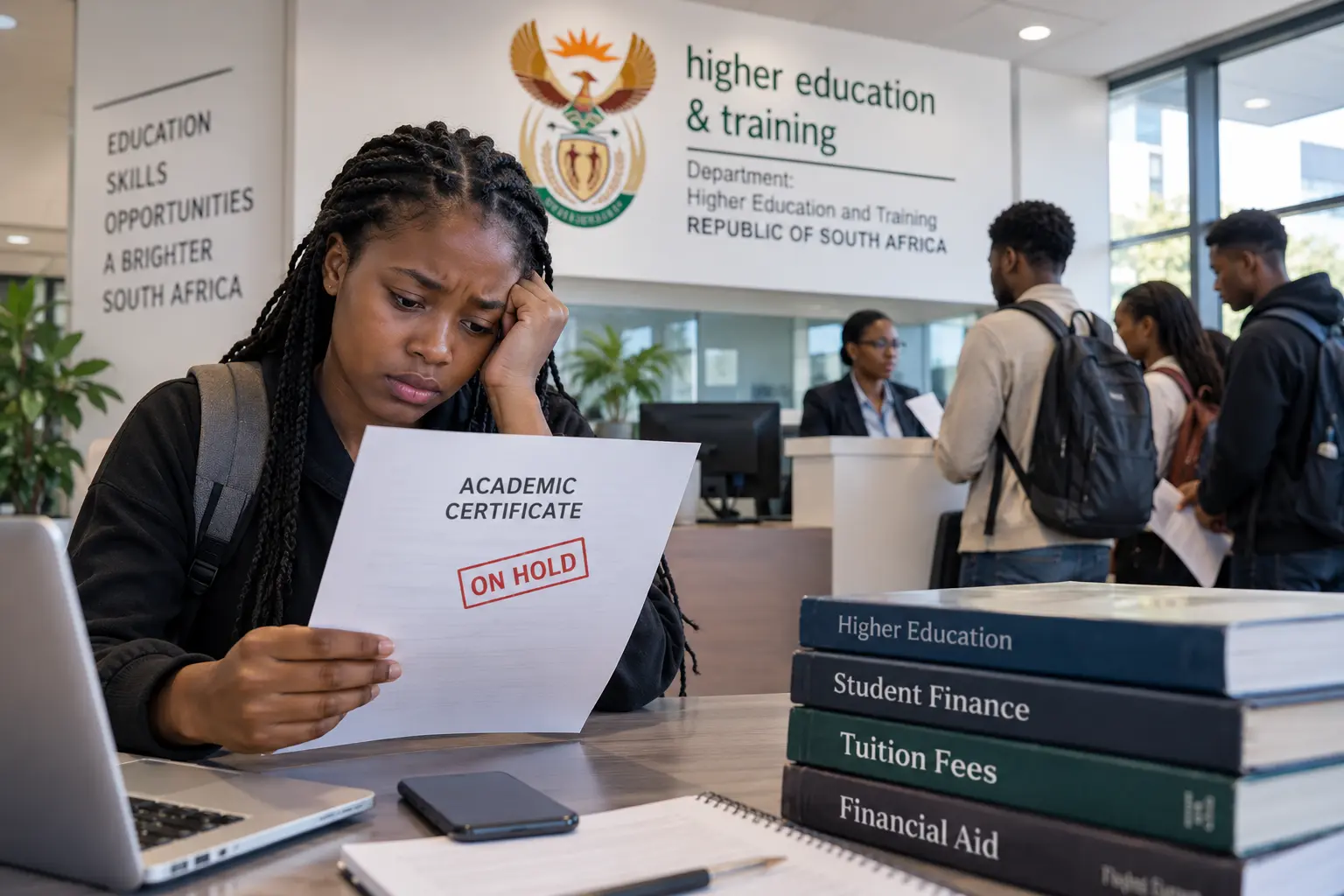
South Africa’s student debt crisis has created a situation in which thousands of graduates are trapped between unpaid university fees and the need for academic record documents to get a job.
The Portfolio Committee on Higher Education and Training has expressed concern at the ongoing accumulation of student debt at universities, universities of technology and TVET colleges after they were briefed on the scale of academic certificates and records being withheld because of outstanding balances.
The effect creates a sort of catch-22 for those affected, in which a lack of academic records will make it difficult to prove one’s qualifications to an employer, but the need for a job may be necessary to pay back the student debt.
Over 165,000 certificates reportedly withheld
The Department of Higher Education and Training (DHET) told the committee that approximately 165,000 qualification certificates are currently being withheld because of outstanding student debt.
Universities South Africa (USAf), however, stated a higher figure of 188,209 certificates being withheld across universities.
The discrepancy in the figures shows why ongoing reconciliation is needed between those involved in the higher education sector.
Whatever the true figure, the scale of the issue has prompted concern about the impact of student debt on those who have graduated but are trying to get a job.
Student debt impacts more than graduates
The committee was told that student debt is not just an issue impacting individual students and universities.
It has a ripple effect in terms of the post-school education and training system, government funding, university finances and the ability of graduates to become employed.
The DHET, USAf and the South African Public Colleges Organisation (SAPCO) briefed the committee on student debt and certificate-withholding issues in post-school education and training.
While the government invests substantially into student funding through the National Student Financial Aid Scheme (NSFAS), the committee was told that ongoing funding and reconciliation problems were contributing to the issue.
Committee warns problem is deteriorating
The portfolio committee chairperson Tebogo Letsie said the fact that student debt continued to increase showed that current interventions were not working,
He also identified the impact on those graduates who leave institutions without their academic records,
as it means they are unable to provide proof of their qualifications to employers, thereby making it more difficult to get a job and pay back their student debt.
In effect, the committee sees a self-perpetuating cycle in which student debt can lead to unemployment and unemployment makes it more difficult to pay back student debt.
Universities of technology have highest debt ratios
DHET told the committee that while universities of technology have the highest debt ratios, traditional universities continue to have substantial debt balances,
The figures show that student debt is a problem affecting all corners of the higher education sector.
It requires a combined response from the government, NSFAS and institutions to resolve.
CPUT, DUT and NWU among universities with large debt balances
According to figures presented by USAf, several universities are carrying billions of rand in terms of student debt.
The figures given included approximately:
Cape Peninsula University of Technology (CPUT): R4.2 billion
Durban University of Technology (DUT): R4.1 billion
North-West University (NWU): R3.8 billion
This shows the impact that accumulated student debt can have on institutions.
TUT has highest number of withheld certificates
USAf also provided figures on certificates being withheld by individual institutions.
The Tshwane University of Technology (TUT) reportedly had the largest number of withheld certificates (24,394).
This was followed by:
Durban University of Technology: 23,155
Cape Peninsula University of Technology: 16,196
For those affected graduates, the issue is not just a case of an unpaid university account, as academic records can be necessary when applying for a job or further studies.
Accommodation is contributing to student debt
Student accommodation has become another source of pressure in the post-school education and training sector.
The committee heard that rising accommodation costs, a lack of affordable student housing, higher transport costs and NSFAS accommodation payment delays have all added to the burden on students and institutions.
When accommodation costs exceed NSFAS funding thresholds, students and institutions can become embroiled in disputes over who is responsible for the outstanding amount.
This can result in additional student debt.
NSFAS reconciliation problems a concern
The committee was told that some NSFAS-related student debt relates to reconciliation problems between NSFAS, accommodation providers and tertiary institutions.
Accommodation charges can exceed applicable NSFAS funding caps, or NSFAS and institutions can fail to complete necessary reconciliation procedures.
These administrative problems can have a direct impact on students who have limited control over disputes between institutions and NSFAS.
Committee member Delmaine Christians warned that students were becoming long-term victims of problems between institutions and NSFAS.
The concern is that students can leave higher education with debt while also facing challenges finding meaningful employment.
TVET colleges are also impacted by student debt
The student debt problem is not just a university issue.
SAPCO reported that more than 20,950 certificates are currently being withheld nationally in the TVET college sector.
Some colleges have particularly large numbers of withheld certificates.
Sekhukhune TVET College reportedly has 10,452 withheld certificates, followed by Letaba TVET College with 5,543.
SAPCO also indicated that some of the outstanding debts date back to 2007-2010, showing that some student-debt issues have been dragging on for years.
Student debt problem can follow graduates for years
The figures tabled before Parliament raise a concern about what happens to students who leave tertiary education with outstanding balances.
A student may have completed the academic requirements for a qualification, but lack the necessary documents to show that they have done so.
At the same time, institutions have to recoup the money owed to them, and they cannot afford to simply waive these amounts.
This creates a conflict between the graduates’ need for documentation to get a job, and the institutions’ need to recover the outstanding student debt.
Committee urges greater collaboration on student debt
The concerns raised by the committee show the need for greater collaboration between DHET, NSFAS, universities, universities of technology and TVET colleges.
Reconciliation of student accounts, resolving accommodation-related funding disputes and clearing historical debt could all help to limit the numbers of those affected.
The committee was also concerned about the effectiveness of the measures currently in place to prevent the proliferation of student debt.
What student debt means for graduates
Graduates can find themselves affected by the student-debt problem in a way that has nothing to do with the university campus.
An academic certificate can be a required document when applying for a job, or for further studies.
If the certificate is withheld, graduates may find themselves unable to get the paperwork required to enter the labour market.
That is why the student-debt problem has grown into a bigger employment concern as much as an issue affecting universities.
Bigger challenge for higher education
South Africa’s student-debt crisis is an illustration of the financial pressures on the post-school education and training sector.
Government funding through NSFAS plays a key role in enabling students to access tertiary education, but unresolved funding, accommodation and reconciliation issues can add to student debt.
Universities and colleges then have to ensure their own financial viability while also addressing the issue of large outstanding student balances.
The challenge for policymakers is to find measures that protect institutions while not adding to the difficulties graduates face when trying to get a job.
For the students who have had their certificates withheld, the problem is particularly acute, as the document they need to prove their education may not be available at the time when they need it most.
Source and reporting note
This article is independently written from information presented during a briefing to Parliament’s Portfolio Committee on Higher Education and Training by the Department of Higher Education and Training, Universities South Africa and the South African Public Colleges Organisation.
The figures relating to withheld certificates and institutional debt are attributed to the organisations that presented them.
Editorial note: The supplied report contains different figures for the overall student-debt burden and its component categories. Because the stated components do not arithmetically reconcile with the stated overall total, this article does not combine them into a single figure without qualification.
Editorial policy
We distinguish between figures presented by government departments, sector organisations and institutions. Where figures differ between sources, we report the discrepancy rather than presenting one figure as definitively correct without further verification.
Disclaimer
The withholding of academic certificates and records is subject to institutional policies, applicable legislation and individual circumstances. Students experiencing financial or academic-record disputes should approach their institution and relevant student-support structures for clarification.
The figures discussed in this article reflect information presented during the parliamentary briefing and may change as institutions and funding bodies reconcile their records.
