
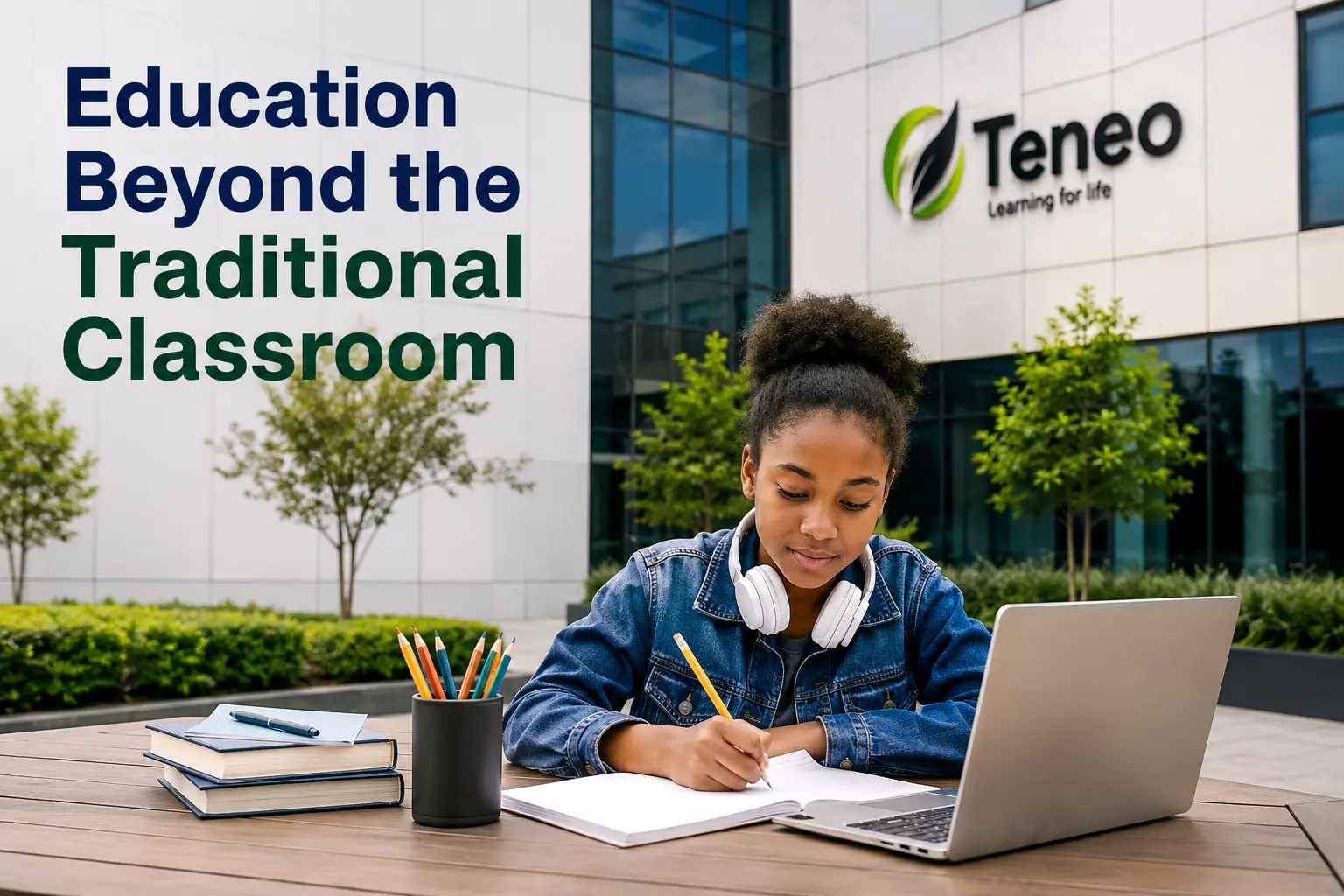
For some South African families, the educational options go beyond what can be experienced in a traditional classroom.
Home education and online schooling can offer a valuable alternative, with opportunities to study in a more flexible manner.
While such options can be appealing to parents who struggle with long daily car journeys, have a learner with sporting commitments or who benefits from a more tailored pace of study
parents need to think through a number of factors before choosing such a route.
The South African Department of Basic Education officially recognises home education as an option, alongside enrolling at a school. Their guidance to parents also includes details about registration and responsibilities.
Why are families considering alternatives to traditional schools?
Although most South African learners will study at a traditional school, that approach is not always best for every child.
Class sizes, lengthy travel times, extra-curricular activities, family needs and a preference for a more tailored approach to learning can all contribute to a family’s decision to pursue an alternative.
Home and online schooling can offer a more flexible approach.
A learner who grasps concepts quickly can move through the syllabus at a faster pace, rather than being held back by the class as a whole, while another learner can spend extra time on challenging topics.
It is important to note that such an option is not necessarily better for all learners in all circumstances, but it can be a good fit for particular children in particular situations.
More flexibility in terms of pace
One of the main advantages of home education lies in its potential to offer a more tailored pace of progress.
In a normal classroom situation, a teacher must plan around the needs of the whole class, rather than individual children.
Online learning opens the door to more flexibility, with opportunities for a child to move through familiar topics at a quicker pace and to spend extra time on more challenging areas.
The same applies to other aspects of the curriculum, with learners able to focus more closely on particular subjects of interest to them.
However, flexibility needs to be balanced with discipline.
A child who learns from home still needs to have a suitable structure and realistic expectations, alongside sufficient assessments to measure their progress.
Reduced travel time
For many families, the school day begins long before the child leaves for school and ends long after they return.
This can be particularly challenging for parents and carers in urban areas trying to navigate rush-hour traffic.
Online schooling can offer more flexibility, with reduced travel time for the child.
This can be particularly important for families with sporting or performing arts commitments, where practice or performances can take place outside core learning hours.
Such an option can also be beneficial to families who find themselves having to move house more often than desired.
It is important to note that flexibility in terms of time does not mean reduced expectations in terms of education.
A child who learns at home or online still needs to dedicate sufficient time and effort to their studies, along with completing all assignments and preparing adequately for assessments.
The potential of digital platforms
For many learners, the ability to access lessons and resources digitally can be a huge advantage.
Online schooling can open the door to such opportunities.
Beyond the potential benefits of a more tailored learning experience, such an option can also ensure that a child acquires valuable digital skills.
By interacting with digital learning resources, a learner can develop digital proficiency while also acquiring organisational and independent working skills.
However, such benefits are dependent on the quality of the online learning experience on offer.
A laptop and internet access are insufficient on their own; the resources, teacher support and overall quality are of vital importance.
The potential for a more tailored approach
Tailored learning is a key reason why many parents pursue home education, rather than traditional schooling or online learning.
Instead of a child sitting in a large class with a teacher trying to cater for everyone’s needs, home learners have the potential to study in a manner more suited to their own requirements.
The South African Department of Education has guidance for parents who wish to pursue this option, noting that there is potential to pursue different curricula, including CAPS, international options, faith-based approaches, eclectic options or self-directed learning, so long as the programme meets certain standards.
Parents have responsibility for ensuring that their child’s needs are met.
CAPS and other curriculum options
From a practical perspective, one of the most important considerations for parents wishing to pursue an online education for their child lies in the curriculum.
The Curriculum and Assessment Policy Statement (CAPS) provides the framework for all school education in South Africa, with the exception of Further Education and Training.
There are also international curriculum options available from various educational providers.
For parents, it is important to ask critical questions, such as:
What curriculum is being followed?
How are assessments conducted?
Who provides teaching and tutoring support?
What qualification is being pursued?
What examination body is involved?
How will the qualification be regarded in higher education?
These questions become even more pertinent as a learner reaches Grades 10 to 12, with their final examinations playing a crucial role in their post-school plans.
Considering the final qualification
When considering an online education, it is important to think through the final qualification and how it fits with the learner’s future plans.
The South African Comprehensive Assessment Institute (SACAI) is an assessment provider accredited by Umalusi to assess the National Senior Certificate (NSC) and GETC: ABET.
SACAI also works with distance education providers to offer the NSC to learners in Grades 10 to 12.
This highlights the importance of thinking through the final qualification, rather than being seduced by the branding of an online school.
The critical consideration lies in the needs of the child and their future needs, rather than what sounds more appealing on paper.
This applies to international qualifications as well, with parents needing to think through how a particular qualification sits with the child’s future tertiary education plans.
The responsibilities of home education
When considering home education, it is important for parents to remember that they bear responsibility for their child’s learning, rather than a school or external organisation.
The Department of Basic Education provides guidance for parents who wish to pursue home education for their child.
Some of the most pertinent considerations include the need to notify the relevant provincial education department and provide evidence of the home education taking place, such as attendance, work, progress and assessments.
Parents should bear this in mind when deciding whether to pursue home education for their child.
The Department’s guidance on home education, which takes effect from 2026, also notes that the implementation of home education falls to the parents, even if a tutor or online learning resources are used for certain subjects.
It is important to understand the difference between home education and full-time online schooling, as the responsibilities of parents differ depending on the approach being followed.
The social development of children
When making an important decision about a child’s education, it is easy for parents to overlook the value of traditional schooling in terms of social development.
While some will automatically oppose home schooling due to the potential impact on a child’s social development, it is important to acknowledge that opportunities for interaction with peers exist outside school, such as with extra-curricular activities.
Parents need to bear in mind the social needs of their child when selecting an educational pathway.
While a home- or online-educated learner will not experience the same social opportunities as someone in a traditional classroom, sport, clubs, community activities, cultural events and other group activities can all play a role in promoting social development and providing opportunities to interact with other children and teenagers.
The value of such an approach will vary from family to family and from learner to learner.
Factors to consider before signing up for online schooling
The cheapest and most convenient option is not always the best one.
Parents considering online schooling for their child need to conduct due diligence before making an expensive commitment
Some of the most pertinent considerations include the following:
Teaching support
Does the child have access to live lessons, pre-recorded materials, tutoring support or a combination of methods?
Curriculum
Does the programme follow CAPS, an international curriculum or another standard?
Assessment and certification
How are tests and examinations conducted, and who provides teaching and tutoring support?
Qualification
What qualification will the child earn, and how does it fit with their future plans?
Costs
What are the additional costs, such as the need for a device and/or stable internet connection?
Attitude of the learner
Is the child suited to such an independent approach to learning?
Not every learner can successfully pursue an online education, regardless of parental support.
Some children need the structure of a traditional classroom to thrive academically.
Online education is not always easier
One of the most common misconceptions about online education lies in the assumption that it involves significantly less work for the learner than traditional schooling.
In practice, a learner following an online education may have to engage with a variety of resources, such as video lessons and online worksheets.
They will also have to submit their completed work for marking, work to deadlines, prepare thoroughly for tests and examinations and communicate digitally with their teachers.
Children are unlikely to learn effectively on their own, which means that parents must still play an active role in their education.
Youth will vary in terms of their capacity to learn independently, so it is important to consider the individual circumstances of the child before pursuing such an approach.
Summary of benefits
For some children and families, the flexibility offered by home or online schooling could be an advantage.
Such an option can offer a more tailored learning experience, helping the child to achieve a better balance between their education and their other commitments.
It can also help reduce the burden associated with long daily travel times for a learner.
Some approaches to online schooling offer greater opportunities for attention and one-to-one support, while other online education providers offer a wider range of curriculum options, including CAPS and international qualifications.
Finally, an online education can provide opportunities for increased independence for learners who need a greater degree of responsibility and time management skills.
These benefits will vary depending on a child’s individual needs, as will the suitability of such an option compared to traditional schooling.
However, such considerations are part of a much wider decision for parents, who must also consider the quality of the programme and the value of parental involvement in a child’s education.
Frequently asked questions
Is homeschooling legal in South Africa?
Home education is legal in South Africa. Parents should be aware that the South African Department of Education has specific guidance for parents considering this option for their child.
Can parents choose a curriculum other than CAPS?
The Department of Education’s guidance makes it clear that parents can choose to follow international curricula, as well as a range of different educational approaches.
Is online schooling the same as homeschooling?
Not necessarily, as a parent following a home education approach has responsibility for their child’s learning, even if they use an online education resource.
The guidance on home education, which will take effect in 2026, sets out the legal responsibilities of parents and makes it clear that online schooling does not relieve a parent of their responsibility for their child’s education.
Can home schooled learners work towards the NSC?
There are assessment options for learners following a home education or distance education, including the opportunity to pursue the NSC. SACAI is an accredited assessment provider that works with distance education learners.
Is online schooling better than traditional schooling?
There is no simple answer to this question, as the value of such an option will depend on the individual needs and circumstances of a child and their family.
Does online schooling mean that a child can study independently without parental supervision?
Not necessarily, as the extent of parental involvement will vary according to the educational provider and the individual needs of the child.
The bigger picture
The potential rise of home education and online schooling does not mean that traditional schooling will disappear, but rather that it plays a smaller role in the lives of some learners.
It reflects a willingness on the part of parents and carers to think creatively in order to meet the needs of their children.
In the same way that one child would benefit from the structure of a traditional classroom, another would gain from the flexibility of an online education, while a third would flourish under a parent-led programme.
In each case, the critical considerations involve the suitability of the programme, the qualifications of the teachers and assessors, the value of the final qualification, and the ability of the child to benefit from such an approach.
For now, the importance for parents in South Africa should be to understand the options and the requirements before making such a significant decision.
After all, flexibility in education has value, but it should not come at the expense of quality or parental involvement.
