
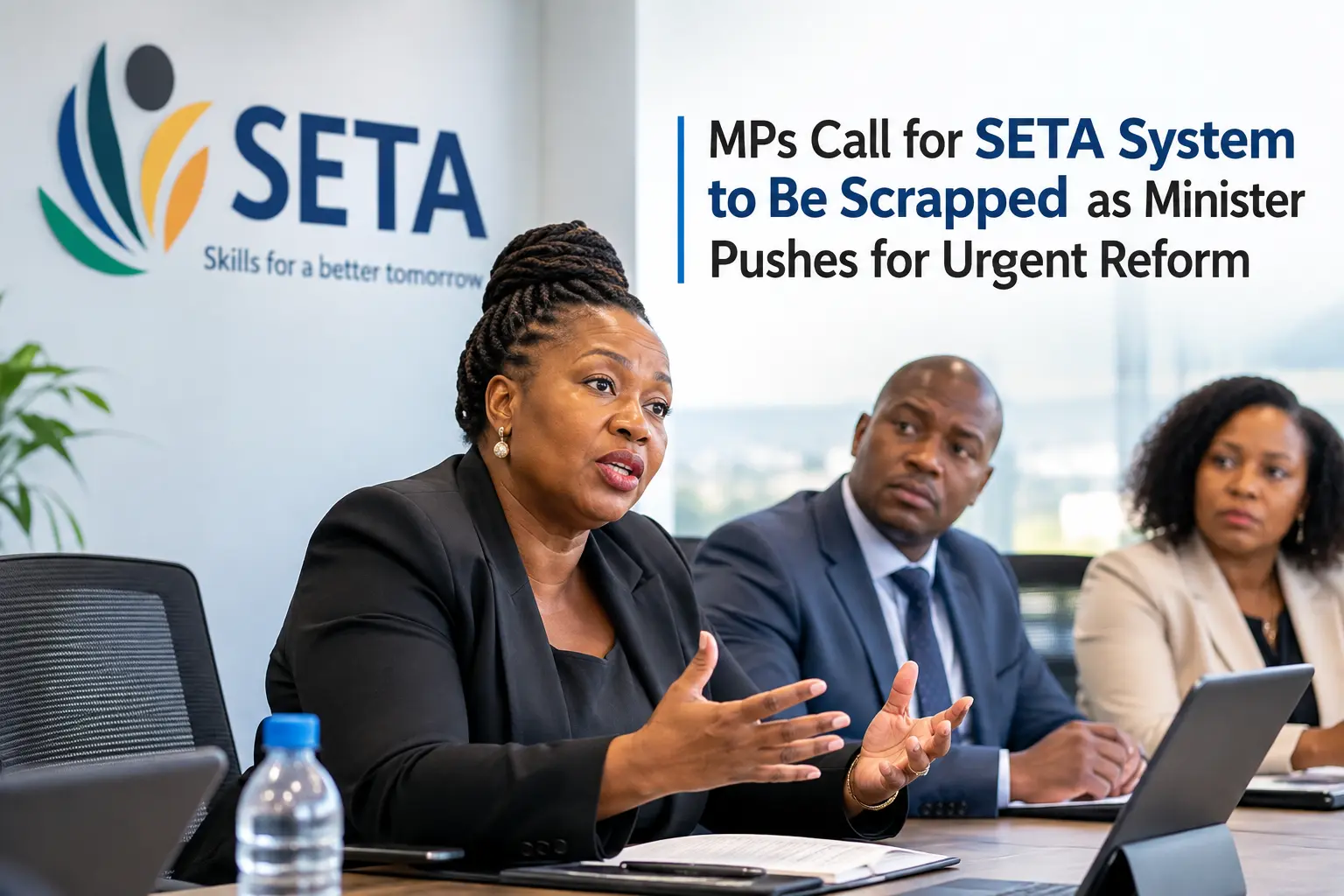
Members of Parliament (MPs) are calling for the fundamental overhaul, and in some cases, the complete abolition of South Africa’s Sector Education and Training Authorities (SETAs), arguing that the system has failed to deliver the skills and employment expected from billions of rands in skills-development funding.
The controversy has led to renewed scrutiny into the future of the country’s 21 SETAs, established more than two decades ago to provide skills and training support in the workplace.
Higher Education and Training Minister Buti Manamela acknowledges serious weaknesses but argues for urgent reform.
MPs question effectiveness.
The calls for abolition are part of the context of the debate of the budget vote on higher education and training in Parliament.
opposition MPs such as representatives of the Democratic Alliance (DA) and Economic Freedom Fighters (EFF) question whether the SETA system is delivering enough economic and employment benefits in contrast to investment in the system.
The criticism comes ahead of South Africa’s ongoing youth unemployment challenge.
The argument is fundamentally that skills-development spending should provide clearer results for South Africa’s youth and economy, in the form of relevant training and employment.
SETAs have been operating for more than 25 years.
South Africa’s SETA system was established more than 25 years ago as part of the country’s approach to workplace skills development.
The 21 SETAs cover various economic sectors and are designed to work in collaboration with employers, workers, training institutions and other stakeholders to address skills needs and support training programmes.
Their activities can range from supporting learnerships and internships, training programmes, bursaries or other interventions depending on the mandate and programmes of the individual SETAs.
For thousands of South Africans, particularly young people looking for opportunities after matric or graduation, SETAs have become an important component of the country’s post-school skills-development framework.
Concerns over governance intensify criticism.
Lawmakers have raised concerns over governance, finance and oversight within the SETA system.
Parliament had previously addressed allegations and concerns involving individual SETAs, including issues of missing or unexplained funds and financial mismanagement.
The cases have intensified questions surrounding the effectiveness of the existing SETA governance systems in safeguarding public resources.
However, individual SETA issues should not be conflated with evidence that each SETA and programme is impacted the same.
Minister argues for reform.
Minister Manamela has acknowledged that the SETA system has significant shortcomings and requires urgent intervention.
However, Manamela’s position differs from MPs who call for the complete system to be dismantled.
Instead of abolishing SETAs, the Minister has advocated for urgent reform to address the weaknesses and improve the system’s effectiveness.
That distinction is crucial in that reform could mean changes to governance, funding, accountability, performance measurement, and interaction between the SETAs and employers without having to abolish the entire system.
Importance to learners
For ordinary South Africans, the parliamentary debate is not only an argument over government structures.
SETAs currently support programmes that can influence whether learners receive training, graduates attain workplace exposure or employers access skills-development support.
Major changes if any are introduced could impact how future learnerships, internships, bursaries or skills programmes are managed and administered.
At this point however, the parliamentary calls for abolition do not mean that SETA programmes have been cancelled.
Learners should continue to check individual opportunities according to the information issued by the relevant SETA.
The central question is employment.
One of the most pressing criticisms raised in the debate is whether skills programmes are translating into employment.
Training numbers do not necessarily demonstrate that a programme has solved one’s employment challenge.
For a young person who completes a learnership, for example, the longer-term value of the experience could depend on whether the experience has led to further training, workplace exposure or employment opportunity.
This has become an increasing concern in the debate regarding SETA performance.
A more outcome-focused system would need to consider not only how many people were trained, but also what happened to them after the training ended.
Potential areas of reform.
If government proceeds with significant SETA reforms, several areas could be scrutinized.
This could include:
SETA boards and accounting authorities’ governance
Financial controls and oversight of expenditure
Selection and monitoring of training programmes
SETA-employer relationship
Measurement of employment outcomes
Administration of grants and funding
Monitoring of learner completion and certification
Greater accountability for programmes that do not achieve their intended outcomes
The exact reforms will depend on the decision made by government and authorities.
No final decision to abolish the entire SETA system has been confirmed by the information supplied for this report.
What students and job seekers should do.
South Africans should not stop pursuing legitimate skills-development opportunities because of the parliamentary debate.
If a SETA advertises a bursary, internship, learnership or skills programme, learners should continue to check the specific opportunity before applying.
Before applying, confirm:
Who is offering the programme
Whether applications are officially open
The qualification or training involved
Eligibility requirements
The closing date
Whether a stipend or other financial support is provided
The official application process
Applicants should also be wary of social-media posts claiming that SETAs have been closed or that government has cancelled all SETA opportunities. Such posts should be verified through official government or SETA communication.
The future of SETAs is under debate.
Parliament’s criticism is a tough question for South Africa’s skills-development system, namely, how the country can ensure that money allocated to skills development benefits learners, workers and the economy.
There is broad consensus that the system must work effectively. The issue is how to achieve that.
Some MPs are calling for the SETA model to be abolished completely, while the Minister’s position is to reform the institutions urgently.
Until government takes any formal changes in the coming time, the existing SETA framework remains in place.
For learners and job seekers, the immediate priority should be checking individual opportunities and understanding the requirements before applying.
Source
This article is based on the supplied information concerning the parliamentary budget vote debate and the position attributed to Higher Education and Training Minister Buti Manamela.
For parliamentary information and statements, readers can consult Parliament of South Africa.
Editorial policy
This article has been independently written for South African readers. It distinguishes between calls from individual MPs, confirmed government positions and unresolved issues. Allegations of corruption or financial misconduct are not presented as proven wrongdoing unless established by an authoritative finding.
No claim has been made that the SETA system has been abolished or that existing programmes have been cancelled.
Disclaimer
The future structure of the SETA system is yet to be determined by government and parliament. Political calls for abolition should not be mistaken for an enacted decision to dissolve the SETAs.
Readers should rely on official government and SETA announcements for changes to programmes, funding or application procedures.
Reader awareness
Students and job seekers should be especially mindful of posts claiming that SETAs are being closed or that guaranteed jobs and bursaries are available due to the parliamentary debate.
Do not pay anyone who promises guaranteed SETA funding, employment or placement. Verify opportunities through official channels before providing identity documents, banking information or other personal details.
