
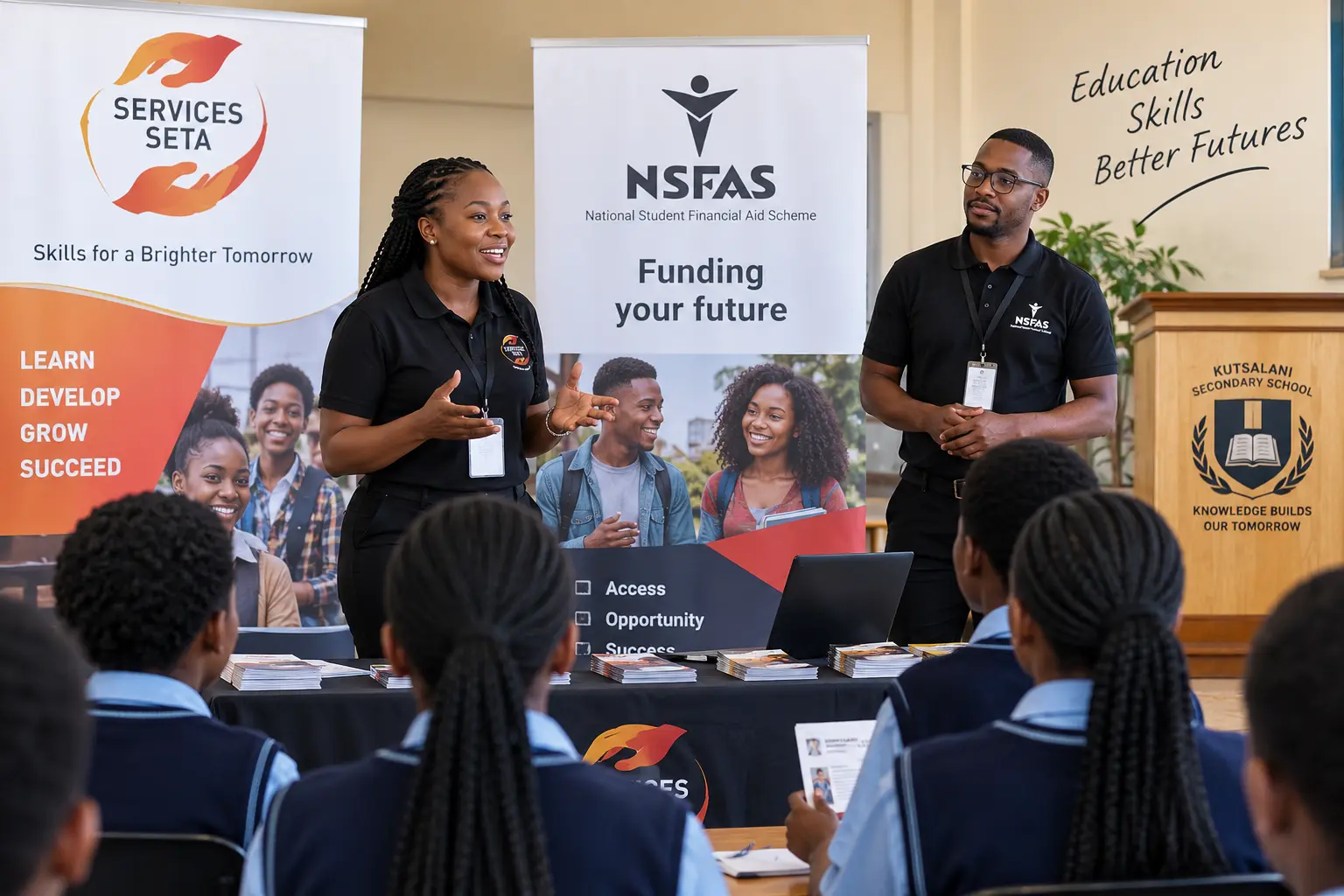
Grade 11 and 12 learners at Kutsalani Secondary School in KaBokweni, Mbombela, have received guidance on funding, post-school education and career opportunities as Services SETA and the National Student Financial Aid Scheme (NSFAS) take part in a learner awareness campaign.
The organisations were addressing a common concern among would-be tertiary students – what opportunities there are after Grade 12, and how to pursue them, including avoiding scams.
Presentations and discussions with learners provided information on financial aid, post-school opportunities and skills development, and served as an eye-opener on the various occupational and artisanal careers available.
With learners set to finish school, the timing was right for them to understand the need to take up further studies, training and funding.
NSFAS warns learners against application fraud
One of the topics covered during the campaign involved the importance of submitting correct documents and information when applying for NSFAS funding.
Vuyani Daweti, NSFAS Risk Specialist, spoke to learners about the consequences of submitting duplicate documents, false information or another person’s personal details when completing an application.
He warned that when applying for financial aid, applicants need to make sure that the information they provide is correct.
In cases where an applicant submits another person’s personal details or information that is not correct, they put themselves at risk of falling for a scam.
Learners encouraged to research before applying
The issue of fake news and the spread of false information through social media has created problems for many young people, especially in relation to bursaries, NSFAS funding, learnerships, college or university applications and job searches.
Learners need to be careful about the information they find online and research it further before applying for any form of financial aid or funding.
This is even more important should the information indicate that an individual has “special” access to a certain funding programme or can “secure” funding for an applicant in return for a percentage of the amount paid.
Learners need to ensure that they use the correct contact details of an organisation to verify information and ask questions before submitting documents, paying any required fees or giving out personal information.
University is not the only option after school
Another benefit of the campaign involved encouraging learners to consider alternative post-school options.
Learners were made aware of various career options, including occupational and artisanal careers.
Learners need to understand that there are a range of post-school options available.
While some people may be better suited for a career at university, others may prefer a vocational or occupational route.
Artisanal careers can also be a good option for learners who are interested in a technical career path.
Learners need to choose the best option according to their interests and needs, as well as the requirements of the specific career.
Grade 11 is not too early to start planning
While Grade 12 is seen as the year of applications and final marks, learners need to remember that the process can begin much earlier.
Learners can take advantage of the extra time to look into their preferred career path and identify the subjects and qualifications needed.
Learners can also look into which institutions offer the required qualification and whether they will be able to afford the fees.
Learners who begin the process earlier have a better chance of identifying gaps in their applications.
This way, when the time comes to apply, they will not be caught off guard and missing out on crucial information.
What learners should research now
Learners who are preparing to leave school can take advantage of the extra time to look into their post-school options.
Some of the first things learners can research include the following:
- What career do I want to pursue?
Learners should identify their preferred careers. It is important that they consider more than one option.
- What subjects/qualifications are needed?
Each qualification has specific requirements. Learners need to find this information and take note of the required subjects and marks.
- Where can I study or get trained?
Learners should look into the options available in relation to their preferred career.
- How much will it cost?
Learners need to take note of the potential costs associated with their preferred qualification so that they can determine which funding options might apply to them.
- What funding options are available?
Learners should research NSFAS and other bursary or financial-aid opportunities to determine which options apply to them.
- When are the applications due?
Learners should take note of the deadlines for funding applications and avoid leaving their applications until the last minute.
Digital resources can help learners find opportunities
Learners also need to take advantage of the many digital resources that are available.
For most young people, the internet plays an essential role in their job search or studies.
However, learners should also keep this in mind when looking for opportunities.
It is important that learners know what to look for online and who they can contact for more information.
A screenshot, WhatsApp message or social media post is not necessarily an official statement, advertisement, announcement or opportunity.
Learners need to use the correct web address and online application portal that applies to the opportunity they are looking for.
Learners need to do their homework to ensure that the information they find online is accurate and relevant to their personal circumstances.
How to protect personal information
Learners should also be more vigilant when it comes to protecting personal information.
This involves ensuring that their personal documents and information are safe and only providing it to trusted people and institutions.
Personal information includes identity documents, school records and application records in relation to studies or jobs.
Learners should also ensure that no unauthorised person has access to their online accounts. This means never sharing login details or passwords.
Learners should also be wary of people claiming to “secure” NSFAS funding, admission to a college or university or employment in return for a percentage.
Message of positivity
Lebogang Kotsi, representative of Services SETA, reminded learners to take advantage of the resources and opportunities available to them.
Kotsi also acknowledged that the road ahead would not be easy and urged them to see the challenges as obstacles that could be overcome.
The message was aimed at learners who feel that their personal circumstances prevent them from making the best choices in relation to their studies and career.
Learners should understand that while access to information cannot solve every problem, it can help them to take the first step.
What learners should take from the campaign
Learners who attended the campaign at Kutsalani Secondary School can begin to take action in relation to their post-school plans.
Learners can start by researching their preferred careers and qualifications, including the required subjects, marks and institutions.
Learners also need to know how to apply for financial aid and funding.
In addition, learners should remember to protect personal information and verify information before taking any action.
For learners who want to leave school and start their studies as soon as possible, the extra time in Grade 11 and 12 should be used to plan ahead and ensure that all options are considered before making any final decisions.
Why the campaign matters
The Services SETA and NSFAS campaign highlights the importance of providing young people with the necessary information to identify and pursue their post-school opportunities.
Learners need to have an understanding of the options available to them.
Learners also need to know how to avoid scams and fraud, including protecting personal information.
For learners in KaBokweni and across South Africa, the message is clear – plan ahead and research post-school options, including the requirements and qualifications, to ensure that they have the best possible chance of pursuing their preferred career.
Sources
This article was independently written using information supplied about the Services SETA and NSFAS awareness campaign at Kutsalani Secondary School in KaBokweni, Mbombela, Mpumalanga.
The comments made by NSFAS Risk Specialist Vuyani Daweti and Services SETA representative Lebogang Kotsi are reported on the basis of the information supplied about the campaign.
Policy
Our policy is to provide accurate, informative and independent information to South African readers.
We make a distinction between reports, opinions and general advice.
We do not guarantee NSFAS funding, admission to an institution, access to a skills programme or employment.
Where application and funding information are provided, readers are encouraged to confirm the latest requirements directly with the relevant institution.
Disclaimer
This article is intended for informational and awareness purposes only.
It is not an official NSFAS or Services SETA announcement in relation to applications for financial aid.
Funding requirements, application deadlines, admission requirements, opportunities and other regulations can change, and learners should confirm the latest information with the relevant institutions before submitting any application.
Fraud awareness: No learner should submit falsified documents, duplicate applications or another person’s personal details when applying for NSFAS funding.
Learners should never allow unverified persons access to their personal information or application portal or provide any information in exchange for “guaranteed” NSFAS funding, admission to an institution or employment.
