
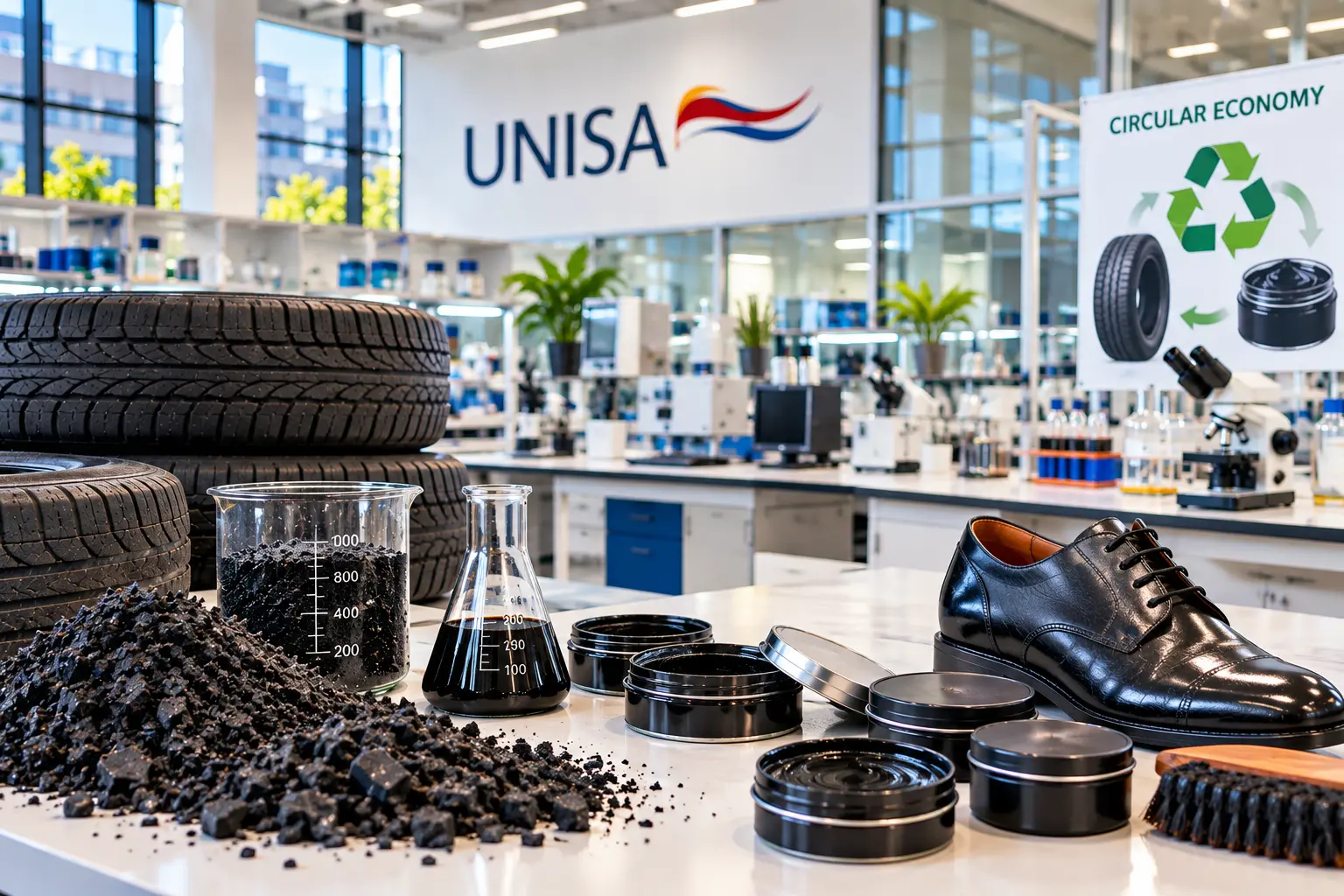
A Unisa professor is using discarded waste tyres to make shoe polish, showing others how materials that are typically thrown away can be made into something else valuable.
Professor Tebogo Mashifana spoke about her work through an inaugural lecture in September 2026, outlining research on the circular economy and finding ways in which waste can be given new use.
The research goes beyond investigating waste as an environmental issue. Mashifana’s research group is developing functional prototypes to show how such waste streams can be made into products of practical use.
From waste to useful products
Waste tyres are a difficult waste stream to manage responsibly, and can have negative environmental impacts if not disposed of properly.
Mashifana’s research considers how waste tyres can be made into products rather than simply seeing them as waste.
One of the applications developed by Unisa is the transformation of discarded tyres into shoe polish.
The work is part of a larger research programme, on turning waste and industrial by-products into materials of use.
Research into the circular economy
The work is part of the wider field of research into the circular economy, which is about finding ways to use materials for as long as possible.
For South Africa, the research has relevance to many industries that generate large volumes of industrial and household waste.
While it is not possible to find uses for all waste, circular-economy research asks whether it is possible to recover materials from a product so that they can be used over again.
Other waste materials are also being studied
The work on tyres is only one part of Mashifana’s wider research programme.
According to information published by Unisa, her research group is also studying a number of other waste materials.
Recovering metals from industrial waste
The team is looking at ways in which metals such as copper and chromium can be recovered from industrial waste.
This means that less metal reaches the waste stream and can be recycled, and potentially creating new products from materials that would otherwise have been thrown away.
Building materials from waste
The research also aims to develop construction materials from industrial by-products, such as fly ash, slag and silica in spent foundry sand.
This work looks at how industrial waste might be incorporated into products like construction materials.
Making plastic and water hyacinth useful
The research is also looking into ways in which plastic waste and invasive water hyacinth can be used to create other products, potentially addressing waste and environmental issues at the same time.
Using mining waste
Mashifana’s team is looking into ways in which gold mine tailings can be used to backfill empty mine voids.
Mine tailings are the waste from processing gold ore, and the research into their use is an important area because of the volumes of tailings created during mining.
From research to products
The strength of the work lies in the fact that it moves beyond academic research, and looks at how practical the use of waste materials can be.
The approach provides a demonstration of what can happen when scientific research meets waste management challenges.
The development of a prototype does not necessarily mean that the product will be available to the public — more work is needed to bring it to market.
Why this matters
South Africa has environmental challenges with waste management in a number of industries, as well as in homes.
There is also an opportunity to recover materials from the waste stream.
Research such as that of Mashifana’s provides one possible model for making that possible.
It shows that there is potential for turning some waste into products rather than seeing disposal as the end of a product’s life cycle.
It also brings together environmental research and opportunities for economic development, innovation and the efficient use of resources.
Looking at waste in a different way
The project on transforming waste tyres into shoe polish is an example of a change in the way some researchers are looking at waste.
Instead of asking simply how waste can be disposed of, researchers ask:
- Can I recover valuable materials from the waste?
- Can I use the waste as an input into something else?
- Can industrial by-products be used to replace some materials?
- Can waste lead to new opportunities for economic development?
- Can new products be designed or created so that resources are kept in circulation?
The research programme of Mashifana’s covers many of these questions in relation to tyres, metals, building materials, plastics, plant waste and mining waste.
What happens next?
While the creation of prototypes is an important step in showing that waste materials can be transformed, each application of such materials must be considered on its own merits before it can be considered for widespread use.
For South Africa, the research is an example of universities playing a role in supporting the development of solutions to environmental and industrial problems, as well as creating products that may not have been possible otherwise.
Fact-checking and editorial
This article is based on information supplied by Unisa, in its publication about Professor Tebogo Mashifana’s research and reports on the project.
It also makes a distinction between research prototypes and commercial products — the article does not suggest that every application researched so far is currently commercially available.
Corrections: If Unisa later publishes updates on this research, its applications or the developments in the various prototypes, this article should be updated with the most recent information.
