
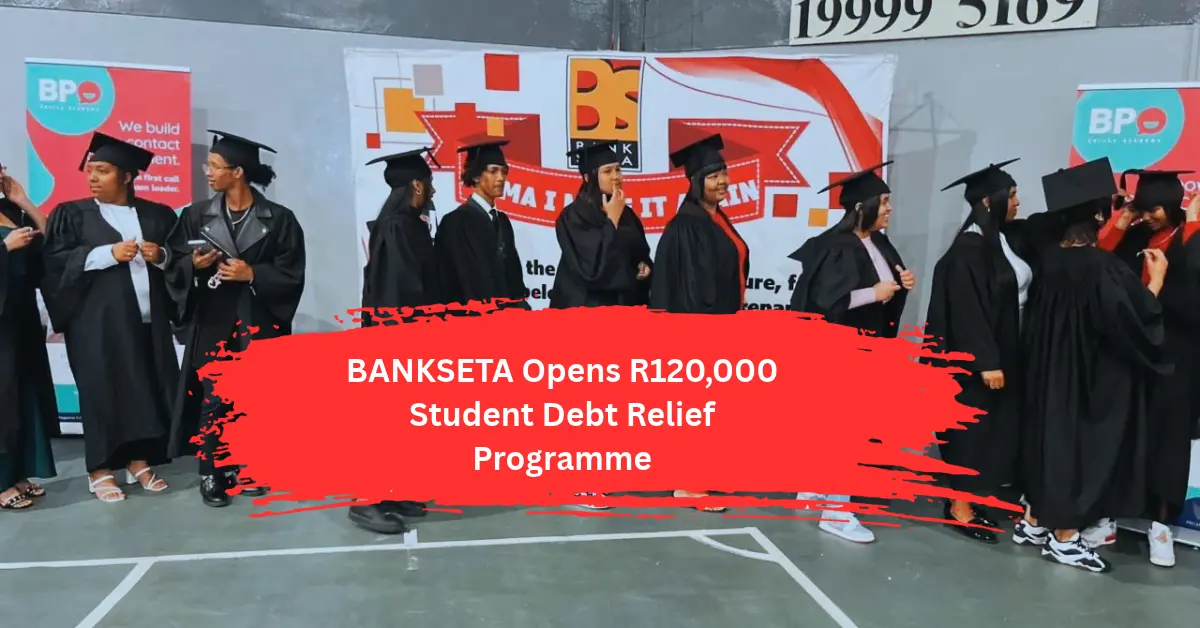
Thousands of South African graduates face a difficult situation after completing their studies: they have passed their qualifications but cannot obtain their academic certificates because of outstanding university or college fees.
The Banking Sector Education and Training Authority (BANKSETA) has opened a new funding opportunity aimed at addressing this challenge.
Through its Historical Student Debt Settlement Programme 2026/27, BANKSETA invites eligible public universities, universities of technology and public TVET colleges to apply for funding to settle qualifying student debt on behalf of unemployed young graduates.
The initiative could help eligible graduates gain access to their qualifications, academic records and opportunities that require proof of completed studies.
However, there is an important application requirement: individual students cannot apply directly to BANKSETA. Their institutions must submit applications on their behalf.
The funding window closes on 10 December 2026 at 16:00, giving eligible institutions a limited period to identify qualifying graduates, verify outstanding balances and submit the required documents.
How much funding is available?
BANKSETA has set a maximum funding limit of R120,000 per qualifying student, subject to the programme’s funding criteria, approval and available budget.
The funding is intended to settle outstanding study debt owed to the institution where the student completed their qualification.
It is not a general bursary for future studies, a monthly stipend or financial assistance for students who still need to complete their qualifications.
The funding guidelines also provide for a 2.5% administration fee for the eligible institutional applicant.
Importantly, R120,000 is the maximum funding cap per beneficiary, not a guaranteed payment to every student. The actual amount considered will depend on the verified outstanding balance and BANKSETA’s approval.
Which institutions can apply?
BANKSETA is accepting applications from the following public institutions:
- Public universities.
- Public universities of technology (UoTs).
- Public Technical and Vocational Education and Training (TVET) colleges.
These institutions are responsible for identifying eligible students, checking their academic records, confirming outstanding debt and submitting the funding application.
Private colleges and private higher education institutions are not included in the eligible applicant categories published for this funding window.
Who qualifies for the BANKSETA student debt programme?
The programme targets unemployed young people who successfully completed full qualifications during the 2026 academic year but cannot obtain their certificates because of outstanding institutional study debt.
According to BANKSETA’s published funding announcement, qualifying beneficiaries must meet the following basic requirements:
- Be unemployed.
- Be under 35 years of age.
- Hold a valid South African identity document.
- Have successfully completed a full qualification during the 2026 academic year.
- Have outstanding institutional study debt preventing the release of their qualification certificate.
There is another important requirement: the qualification must align with skills identified in BANKSETA’s applicable Sector Skills Plan, including relevant priority or emerging occupations.
Meeting the basic age, citizenship and unemployment requirements does not automatically guarantee funding. The institution must verify the student’s eligibility against the full funding guidelines.
Women and persons with disabilities receive priority consideration
BANKSETA’s November 2026 funding guidelines state that priority will be given to:
- Women.
- Persons with disabilities.
This priority consideration forms part of the funding assessment. It does not remove the other eligibility requirements or guarantee that an application will be approved.
Institutions should ensure that the relevant supporting information is included when submitting beneficiary applications.
How to apply for the BANKSETA Historical Student Debt Settlement Programme
The application process is institution-led. Students cannot submit their own applications directly to BANKSETA.
If you believe you qualify, take the following steps.
Step 1: Contact your university or TVET college
Approach your institution’s financial aid office, student accounts department, student funding office or relevant administration department.
Explain that you completed your qualification during the 2026 academic year but cannot obtain your certificate because of outstanding fees.
Ask whether the institution intends to apply for the BANKSETA Historical Student Debt Settlement Programme.
Step 2: Confirm your outstanding study debt
Ask the institution to check your student account and confirm the amount that remains unpaid.
BANKSETA’s guidelines require institutions to establish the net outstanding balance after accounting for bursaries, NSFAS payments and other credits.
The same debt cannot be claimed twice or funded by another source for the same outstanding balance.
Step 3: Confirm that you meet the eligibility requirements
The institution must verify your unemployment status, age, South African identity documentation, academic completion and outstanding debt.
It must also check that the qualification meets the programme’s sector skills alignment requirements.
Step 4: Provide the supporting documents
Your institution may request documents such as:
- A certified copy of your South African ID.
- Academic results or proof of successful qualification completion.
- A student account statement showing outstanding debt.
- A debt settlement agreement, where applicable.
- Other supporting documents required by BANKSETA.
The institution is responsible for checking the required documentation and submitting the beneficiary information in accordance with the funding guidelines.
Step 5: The institution submits the application
Eligible institutions must complete the prescribed application documents and submit them through the BANKSETA Information Management System (SIMS).
Applications submitted through other channels or received after the prescribed deadline will not be accepted.
BANKSETA application deadline
The funding window opened on 10 November 2026 and closes on 10 December 2026 at 16:00.
This is the deadline for institutional submissions, not a direct student application deadline.
Students should contact their institutions as early as possible. Universities and colleges may set earlier internal deadlines to allow enough time to verify student information, confirm debt balances and prepare their submissions.
Waiting until the final day could make it difficult for an institution to complete the necessary checks.
What happens after an institution applies?
Submitting an application does not automatically mean that BANKSETA will settle the debt.
The authority evaluates institutional applications against the published funding criteria, supporting documentation, sector priorities and available budget.
Institutions are responsible for verifying the information supplied about beneficiaries and their outstanding balances.
BANKSETA may also request additional supporting documents during evaluation, contracting, payment or reporting.
Where funding is approved, the institution must follow the applicable agreement and payment conditions before settling the qualifying debt.
Students should therefore continue communicating with their institutions rather than assuming that their fees have already been cleared once an application is submitted.
Does this programme cover new tuition fees or monthly stipends?
No. This funding window has a specific purpose: settling qualifying outstanding study debt for eligible students who completed full qualifications during the 2026 academic year.
BANKSETA’s official guidelines expressly exclude:
- New training delivery.
- Equipment purchases.
- Learner stipends.
- Unrelated institutional costs.
It should therefore not be advertised as a general bursary or learnership opportunity.
Students who still need financial assistance to complete their studies should investigate other bursaries, NSFAS support where applicable, and separate institutional funding opportunities.
Why this funding opportunity matters to unemployed graduates
Completing a qualification does not always mean that a graduate can immediately use it to pursue employment.
Outstanding university or college fees can prevent students from obtaining certificates and academic documents needed for further studies, professional opportunities and certain recruitment processes.
By supporting the settlement of qualifying study debt, BANKSETA aims to remove one of the financial barriers facing unemployed graduates.
The programme also highlights the importance of collaboration between public institutions and sector education authorities in addressing skills shortages and improving access to employment opportunities.
For eligible graduates, the first practical step is not to search for an individual BANKSETA application form. It is to contact the institution holding their outstanding account and establish whether they can be considered for inclusion in its application.
Official BANKSETA application details
| Information | Details |
|---|---|
| Funding authority | Banking Sector Education and Training Authority (BANKSETA) |
| Programme | Historical Student Debt Settlement Programme 2026/27 |
| Maximum funding | R120,000 per qualifying student |
| Eligible applicants | Public universities, UoTs and public TVET colleges |
| Intended beneficiaries | Eligible unemployed students who completed full qualifications in 2026 |
| Opening date | 10 November 2026 |
| Closing date | 10 December 2026 at 16:00 |
| Application method | Institutional application through BANKSETA SIMS |
| Direct student applications | Not accepted |
Official funding announcement:
https://bankseta.org.za/funding-window-1/discretionary-grant-unemployed-beneficiaries-outstanding-study-debt-settlements/
Official application portal:
https://sims.bankseta.org.za/login
Funding guidelines:
Download the November 2026 Outstanding Study Debt Settlement Funding Window Guidelines from the official BANKSETA funding announcement.
Frequently Asked Questions
1. Can individual students apply directly to BANKSETA?
No. Individual students cannot submit direct applications. Eligible public universities, universities of technology and public TVET colleges must apply on behalf of qualifying students.
2. How much can BANKSETA pay towards outstanding student debt?
The funding is capped at R120,000 per qualifying beneficiary, subject to the verified debt balance, funding criteria, approval and available budget.
3. Can students who received NSFAS previously qualify?
Previous NSFAS assistance does not automatically establish eligibility or disqualification. However, the institution must calculate the remaining unpaid balance after accounting for NSFAS, bursaries and other payments. The same debt cannot be funded twice.
4. Can students who are still studying apply?
This particular funding window is intended for unemployed beneficiaries who successfully completed full qualifications during the 2026 academic year. It is not intended to fund ongoing studies.
5. Can graduates from private colleges apply?
The published eligible institutional applicants are public universities, public universities of technology and public TVET colleges. Private institutions are not included in the stated applicant categories.
6. Does every qualifying student receive R120,000?
No. R120,000 is the maximum funding cap per beneficiary. The amount considered depends on the verified outstanding debt and approval under the funding guidelines.
7. What is the closing date?
Eligible institutions must submit their applications by 10 December 2026 at 16:00. Students should contact their institutions before this date because internal processing deadlines may be earlier.
Sources and Verification
This report is based primarily on BANKSETA’s official funding announcement and its November 2026 funding guidelines.
Primary source:
- BANKSETA – Outstanding Study Debt Settlement Funding Window. Confirms the funding purpose, eligible institutional applicants, student eligibility and closing date.
- BANKSETA – November 2026 Funding Guidelines. Provides the detailed funding conditions, R120,000 beneficiary cap, administration fee, qualification alignment requirements, priority groups and institutional responsibilities.
- BANKSETA SIMS Portal. Official online submission platform for eligible institutional applicants.
Editorial Note
The article distinguishes between the institutions permitted to apply and the students who may benefit from the funding. BANKSETA’s official documentation confirms that individual students cannot apply directly. The programme is specifically aimed at unemployed South African ID holders under 35 who completed full qualifications during the 2026 academic year but cannot obtain their certificates because of outstanding institutional debt.
The R120,000 amount is a funding ceiling, not a guaranteed payment. Funding remains subject to qualification alignment, verification of debt, approval and available budget. The programme does not cover new training, equipment, stipends or unrelated institutional expenses. Readers should confirm their eligibility and any internal submission deadlines directly with their public institution.
This content was checked and verified by professional auditors and Admin Staff
