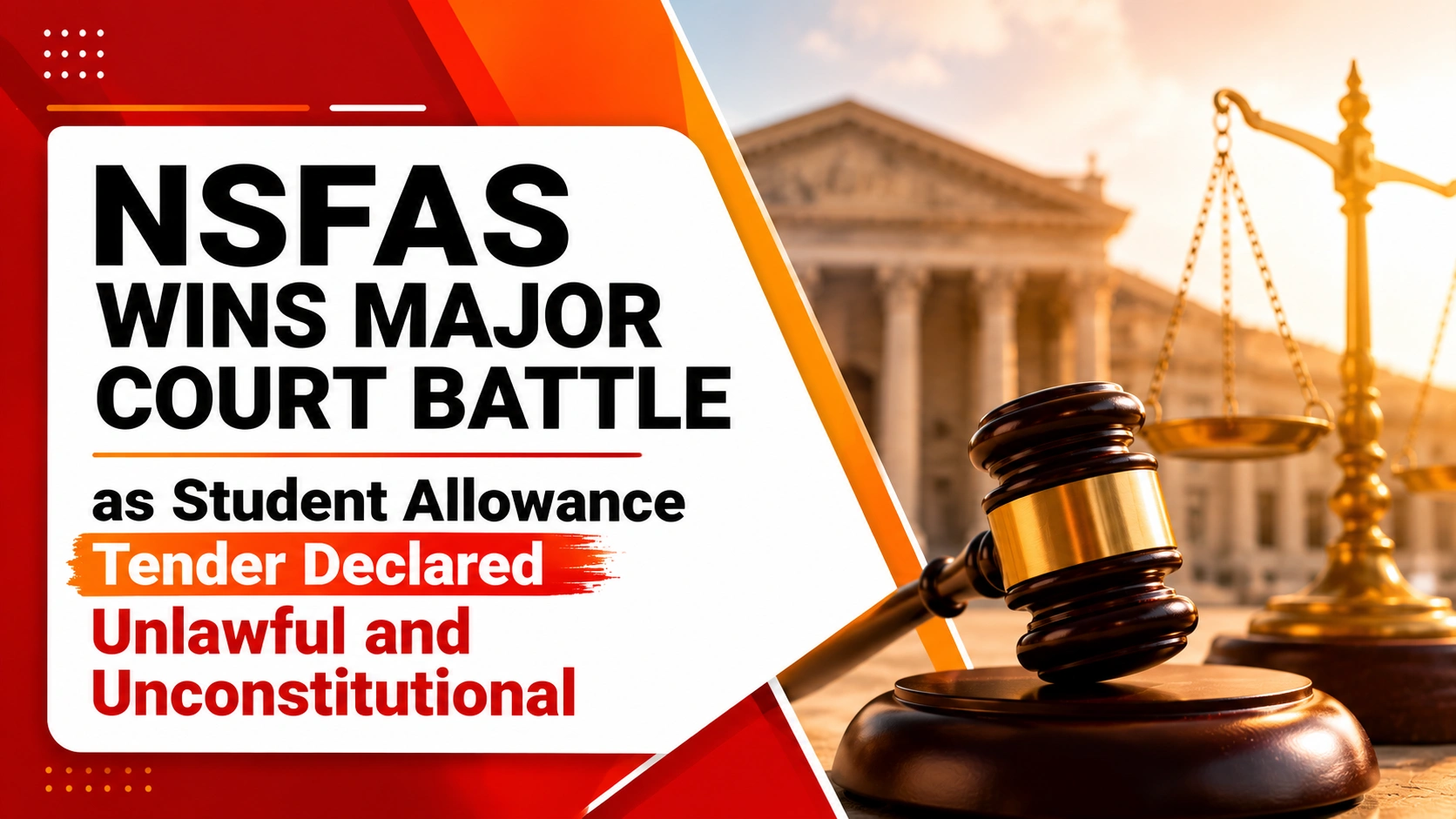
The National Student Financial Aid Scheme and the Special Investigating Unit have welcomed a landmark ruling by the Western Cape High Court declaring the controversial student allowance payment tender involving four service providers unlawful, invalid, and unconstitutional.
The judgment is being viewed as a significant victory for transparency, accountability, and good governance in the management of billions of rand allocated to student financial aid across South Africa.
The ruling follows years of scrutiny surrounding the procurement process used to appoint private fintech companies responsible for distributing student allowances to NSFAS beneficiaries.
Court Sets Aside Controversial NSFAS Payment Contracts
On 12 June 2026, the Western Cape High Court ruled that the procurement process which resulted in service-level agreements between NSFAS and four payment service providers failed to comply with constitutional and procurement requirements.
The affected companies are:
- eZaga Holdings
- Coinvest Africa
- Noracco Corporation
- Tenet Technology
According to the court, the tender process contained multiple irregularities that undermined the legality of the contracts.
Why the Court Found the Tender Invalid
The judgment identified several procurement failures during the awarding of the contracts.
Among the issues highlighted were:
- Improper cancellation of previous tender processes
- Irregular drafting of bid documentation
- Deficiencies in tender approval procedures
- Failure to comply with mandatory procurement requirements
- Weaknesses in internal governance controls
- Administrative irregularities during the evaluation process
The court concluded that these failures rendered the procurement process unconstitutional and unlawful.
Investigation Exposed Governance Concerns
The ruling follows investigations into the awarding of the payment contracts and governance practices within NSFAS.
In 2023, the NSFAS board initiated steps to terminate the service agreements after a report compiled by legal firm Werkmans Attorneys identified concerns regarding the procurement process.
The investigation also raised questions about an alleged relationship involving former NSFAS Chief Executive Officer Andile Nongogo and two of the service providers.
The findings prompted increased scrutiny of procurement decisions and governance practices within the student funding scheme.
NSFAS and SIU Welcome the Judgment
In a joint statement, NSFAS and the SIU said the ruling reinforces their efforts to address governance failures and strengthen accountability in public procurement.
According to the organisations, the judgment supports ongoing efforts to ensure that public funds intended for students are managed transparently and in accordance with the law.
The institutions emphasized that protecting the integrity of student funding systems remains a priority.
No Finding of Corruption Against Service Providers
While the court invalidated the contracts, it also found no evidence that the service providers themselves participated in corruption, maladministration, or wrongdoing.
This distinction is important because it means the companies are not being held liable for the procurement irregularities identified by the court.
Instead, the judgment focuses on flaws within the procurement process itself.
Companies May Seek Compensation
The court has allowed the affected service providers to submit claims for reasonable expenses and profits incurred while carrying out services under the now-invalid contracts.
Any compensation claims submitted will undergo an independent verification process before payment is considered.
NSFAS has indicated that it intends to engage constructively with the affected companies to implement the court’s directives in a lawful and transparent manner.
What This Means for Students
For current and future NSFAS beneficiaries, the ruling is unlikely to affect funding eligibility or the broader mandate of the student financial aid scheme.
Instead, the judgment is expected to contribute to improved governance and oversight of future service provider appointments.
NSFAS has reassured students, parents, and stakeholders that it remains committed to:
- Protecting public funds
- Strengthening governance systems
- Improving procurement oversight
- Maintaining accountability
- Ensuring effective student support services
The organisation says restoring public confidence remains a key priority.
Why the Ruling Matters
The NSFAS payment tender controversy has become one of the most closely watched governance issues in South Africa’s higher education sector.
The court’s decision sends a strong message about the importance of:
- Transparent procurement processes
- Compliance with constitutional requirements
- Accountability in public institutions
- Responsible management of taxpayer-funded programmes
Governance experts believe the ruling may influence how public entities approach procurement and contract management in the future.
Final Thoughts
The Western Cape High Court’s decision represents a major development in the ongoing efforts to improve governance within South Africa’s student funding system. By declaring the payment tender invalid, the court has reinforced the importance of lawful procurement and accountability in the management of public resources.
As NSFAS and the SIU continue to implement reforms, many stakeholders will be watching closely to see how future student allowance systems are structured to ensure transparency, efficiency, and public trust.
Sources and References
- Joint statement by NSFAS and the Special Investigating Unit (SIU).
- Western Cape High Court judgment regarding NSFAS student allowance payment tenders.
- Findings from investigations into the NSFAS payment service provider procurement process.
Editorial Transparency
This article is based on official statements and court findings relating to the NSFAS student allowance payment tender matter. The information presented reflects publicly available details at the time of publication. Readers should refer to official court records and NSFAS communications for further updates.
