
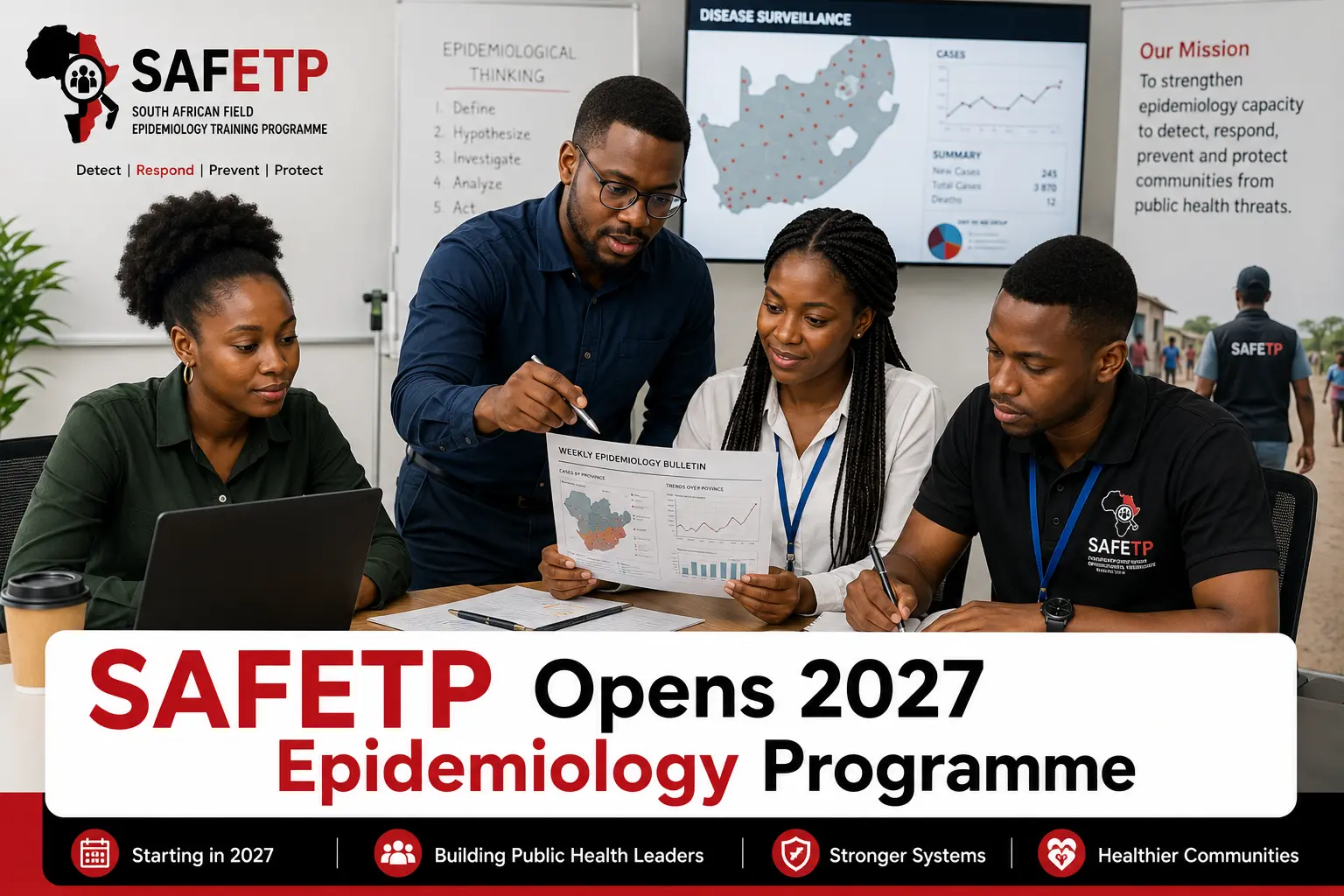
NICD, Wits and UP Seek Public Health Professionals for Prestigious Epidemiology Residency
The South Africa Field Epidemiology Training Programme (SAFETP) has officially opened applications for its 2027 intake, offering healthcare, veterinary, environmental health, and public health professionals an opportunity to receive advanced epidemiology training while contributing to disease surveillance and outbreak response across South Africa.
The programme is coordinated by the National Institute for Communicable Diseases (NICD) in partnership with the University of Pretoria (UP) and the University of the Witwatersrand (Wits). It is designed to strengthen South Africa’s public health workforce by developing skilled epidemiologists capable of responding to emerging health threats and improving population health outcomes.
For professionals passionate about public health, research, disease prevention, and health system strengthening, SAFETP remains one of the most respected training programmes in Southern Africa.
Programme Overview
| Programme | South Africa Field Epidemiology Training Programme (SAFETP) |
|---|---|
| Intake | 2027 |
| Programme Type | Field Epidemiology Residency |
| Coordinating Institution | National Institute for Communicable Diseases (NICD) |
| Academic Partners | University of Pretoria & University of the Witwatersrand |
| Focus Areas | Epidemiology, Disease Surveillance, Public Health Research |
| Training Model | Academic Study and Field-Based Learning |
| Location | South Africa |
What Is SAFETP?
The South Africa Field Epidemiology Training Programme is a workplace-based training programme that combines formal academic study with practical field experience.
Participants spend the majority of their time working on real public health challenges, including:
- Disease outbreak investigations
- Surveillance system evaluations
- Epidemiological research
- Public health data analysis
- Emergency response activities
- Health programme evaluations
The programme follows internationally recognised Field Epidemiology Training Programme (FETP) standards and contributes to strengthening health security across the region.
Why Epidemiology Matters More Than Ever
Recent disease outbreaks and public health emergencies have highlighted the importance of skilled epidemiologists.
These professionals play a critical role in:
Detecting Disease Outbreaks
Early detection helps limit the spread of infectious diseases and protects communities.
Analysing Health Trends
Public health data provides insights that help governments make informed healthcare decisions.
Improving Health Programmes
Evidence-based research strengthens healthcare interventions and policy development.
Supporting Emergency Responses
Field epidemiologists are often at the forefront of responding to outbreaks and public health crises.
As South Africa continues investing in healthcare system strengthening, demand for trained epidemiologists continues to grow.
Educational Requirements
Applicants must possess one of the following qualifications:
Option 1
Medical Degree
Option 2
Veterinary Degree
Option 3
Dentistry Degree
Option 4
Doctorate Degree in a One Health-related field
Option 5
Master’s Degree in a One Health-related field
Option 6
Honours Degree or Bachelor’s Degree with prior research experience
All qualifications should be obtained from accredited institutions and relate to:
- Human Health
- Animal Health
- Public Health
- Environmental Health
- One Health disciplines
Work Experience Requirements
Applicants must have:
✔ At least two years of professional experience
Experience may be in:
- Human health
- Veterinary services
- Agriculture
- Environmental health
- Public health
Additional Advantages
The following experience may strengthen an application:
- Public health system experience
- Research experience
- Epidemiology projects
- Disease surveillance work
- Programme monitoring and evaluation
Additional Eligibility Requirements
Applicants must also:
✔ Be registered with their relevant professional body
✔ Be fluent in spoken and written English
✔ Be computer literate
✔ Be proficient in Microsoft Office applications
✔ Be capable of producing reports and presentations
✔ Possess a valid driver’s licence
✔ Be willing to travel and drive hired vehicles
✔ Provide proof of residential address
Knowledge of statistical software packages will be considered an advantage.
Academic Pathways
University of Pretoria
Applicants should apply for:
First Choice
BSc (Hons) Epidemiology and Biostatistics
Second Choice
MSc Epidemiology and Biostatistics
Applicants who already hold an appropriate Honours qualification in Epidemiology may apply directly for the MSc programme.
University of the Witwatersrand
Applicants should apply for:
Master of Science in Epidemiology
Specialisation:
Field Epidemiology
Both university applications are required in addition to the SAFETP application.
Required Application Documents
Applicants must prepare the following:
- Certified qualification certificates
- Certified academic transcripts
- Updated two-page Curriculum Vitae (CV)
- Statement of Purpose (maximum 500 words)
- Proof of university applications
- SAQA evaluation for foreign qualifications (if applicable)
Statement of Purpose Requirements
Applicants must explain:
- Career goals
- Public health interests
- Reasons for applying to SAFETP
- Long-term professional aspirations
A strong and well-structured statement can significantly improve an application’s competitiveness.
Highly Competitive Selection Process
SAFETP is one of South Africa’s most competitive public health training programmes.
Applications are assessed based on:
Academic Qualifications
Educational performance and relevance of qualifications.
Professional Experience
Experience within healthcare, research, or public health environments.
Application Quality
Completeness and strength of submitted documents.
Interview Performance
Shortlisted applicants may be invited to attend interviews and additional assessments.
Only the strongest candidates will be selected.
Career Opportunities After Graduation
Graduates may pursue careers as:
Public Health Epidemiologists
Investigating disease patterns and supporting health policy decisions.
Disease Surveillance Specialists
Monitoring health threats and strengthening surveillance systems.
Research Scientists
Conducting public health and epidemiological studies.
Outbreak Response Officers
Supporting emergency health responses during disease outbreaks.
Programme Managers
Managing public health initiatives and disease control programmes.
International Health Professionals
Working with organisations such as WHO, Africa CDC, NGOs, and research institutions.
How to Apply
Step 1
Complete the official SAFETP online application.
Step 2
Apply separately to:
- University of Pretoria
- University of the Witwatersrand
Step 3
Upload all required supporting documents.
Step 4
Submit applications before the relevant university and programme deadlines.
Incomplete applications will not be considered.
Contact Information
SAFETP Secretariat
Eudie Hlabioa
☎ +27 11 386 6542
University of Pretoria
Lesiba Mpati
☎ +27 12 356 3292
University of the Witwatersrand
Lerato Podile
☎ +27 11 717 2605
Expert Insight
Public health experts consistently identify field epidemiology as one of the most critical disciplines for strengthening health systems and improving outbreak preparedness.
As governments continue investing in disease surveillance, health security, and evidence-based healthcare planning, specialised epidemiology skills remain highly sought after both locally and internationally.
The SAFETP programme provides a unique opportunity to gain these skills while contributing directly to public health improvement.
Final Thoughts
The South Africa Field Epidemiology Training Programme 2027 offers an exceptional opportunity for healthcare and public health professionals seeking advanced training, practical field experience, and meaningful career development.
For individuals committed to improving population health, preventing disease outbreaks, and strengthening healthcare systems, SAFETP represents a pathway toward becoming a leader in public health and epidemiology.
Sources and References
- South Africa Field Epidemiology Training Programme (SAFETP)
- National Institute for Communicable Diseases (NICD)
- University of Pretoria
- University of the Witwatersrand
- Field Epidemiology Training Programme Guidelines
Editorial Transparency
This article is published for educational and informational purposes. Programme requirements and admission criteria are based on information published by SAFETP and partner institutions. Applicants should verify all deadlines, admission requirements, and application procedures through official SAFETP, NICD, UP, and Wits platforms before applying.
Published: June 2026
Category: Public Health, Research Opportunities, Professional Development, Healthcare Careers
